

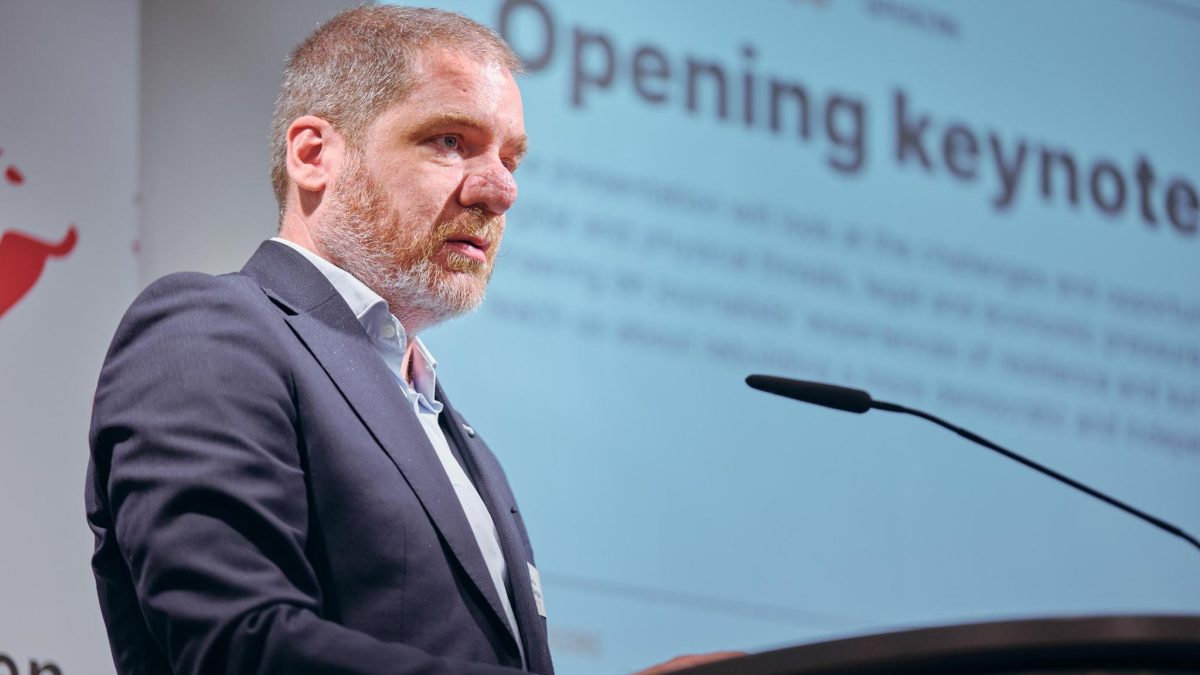
After surviving 16 years in independent Hungarian media under former prime minister Viktor Orbán, HVG chief editor Márton Gergely talked of competition from an “influencer government” at a press-freedom summit in Brussels on 12 October.
Gergely points to live-broadcasts around the clock on YouTube and Facebook. And as if to prove his point, Prime Minister Péter Magyar took to Facebook on 14 October, just hours after a HVG article, reprimanding the weekly, ranked Hungary’s most trustworthy in a 2025 Reuters Institute survey, for reporting on resignations within his government.
Péter Magyar’s Facebook page, with 1.7 million followers on 15 October, amplifies such messaging far beyond the reach of HVG’s 721,000 followers despite the weekly building its digital presence since 1979.
“It might do good for the reputation of the free press if they didn’t spread clearly debunked lies on the level of [Ed. Hungarian political advertising agency] Megafon,” Prime Minister Magyar warned on 14 October.
A different kind of competition
The new government brings a new test, Gergely said. With media consumption shifting to video platforms and social networks, “we are competing for readership or viewership under the same circumstances as political parties”.
His answer goes back to Orbán’s 2018 victory. Orbán had fought the election on migration, liberal journalists set about debunking his claims, and he still won a two-thirds majority. Gergely concluded that debunking was not the point of the job. “It is to be relevant, it is to tell stories,” he said. “It is not to run behind others and try to fact-check them, but first to write stories that get the facts straight.”
HVG will therefore “stick to our media as it was”. There would be times when that was “really hard”, he said, “but in the end, this is the only way I have”.
Sixteen years of capture
Orbán’s inner circle had long held that “whoever controls the media of a country controls the country itself”, said Gergely, editor of Hungary’s leading economic and political weekly.
Orbán’s programme began with the “total restructuring” of public broadcasting and never stopped, he said, using ownership changes, new laws and a market distorted by “an awful lot of state money”, all while working around European rules that might have slowed it.
A heavy blow came in October 2016, when Népszabadság, then the country’s biggest daily where Gergely was deputy editor-in-chief, was closed overnight. Other titles followed, until only a handful of outlets remained. Surviving “needed creativity, clever financing”, he said, “and also a lot of days where we were not sure how to continue”.
Idealism and stupidity
Many of the best reporters left. One investigative journalist retrained as an electrician. When he wired his first circuit and the light came on, he told Gergely: “That was the first time in 12 years that something I’ve done professionally had a consequence.” Leaving was probably right for the individual, Gergely said; staying was right for the profession.
“To be a Hungarian journalist needs idealism or stupidity, but actually both,” he said. “You have to be just stupid enough.”
‘It’s not our job’
HVG had not changed its approach to help bring Orbán down. “We haven’t done anything differently than four years back,” Gergely said. At a private event, he recalled, a member of the now-governing Tisza party asked why independent media had not done more to help, arguing that they would be punished too if Tisza lost.
“It’s not our job. Our job is to somehow maintain independent journalism in Hungary. And it’s not about the chances, it’s about the ideal.”
There was “good news in the defeat”, he said: “Now authoritarians all around the world know that they can build the perfect media system and even that won’t keep them safe from a humiliating defeat.”
Surfacing after the election
April’s election defeat for Orbán had come with little time to adjust, Gergely said. “We somehow feel ourselves like scuba divers who have been 200 metres deep underwater and accustomed to the pressure,” he said. “The election has grabbed us suddenly from 200 metres and dropped us to the surface.” For some, the speed of the ascent was dangerous; “for us, a busy moment”.
A continent-wide squeeze
Hungary’s experience sits within a wider pattern. Mapping Media Freedom, the monitoring project of the Media Freedom Rapid Response (MFRR) consortium that organised the summit, documented a total of 736 attacks on 1,174 journalists and other media professionals in EU member states and candidate countries in the first half of 2026. The monitoring recorded 47 cases of detention, arrest or imprisonment of 61 journalists across Europe. Türkiye accounted for 42 of the cases (89%), the rest in Georgia, Serbia and Spain.
While most attacks are verbal insults and discreditation, Mapping Media Freedom also records death threats, hacking, spoofing, doxing and surveillance.
Private platforms, public debate
Leopoldo Maldonado, the UN special rapporteur on freedom of opinion and expression, told the summit the threat was no longer only about governments. States remained the main duty-bearers, but “a substantial part of the infrastructure through which public debate is now privately owned”. Platforms shape “what becomes visible, what is amplified”, he said, and have absorbed advertising revenue that once supported journalism.
Protection must cover devices, data and sources as well as physical safety, Maldonado said, and careless use of terms such as disinformation could lead to “disproportionate restrictions”. Public-service media cannot be independent “if their institutional or financial foundations are vulnerable to political control”, he said. “Media viability is not simply a business question. It is a freedom of expression question.”
Sources
- MFRR Summit 2026 — https://www.mfrr.eu/summit/2026/
- Media Freedom Rapid Response (MFRR) — https://www.mfrr.eu/
- European Centre for Press and Media Freedom — https://www.ecpmf.eu/
- HVG — https://hvg.hu/
- OHCHR — https://www.ohchr.org/en/special-procedures/sr-freedom-of-opinion-and-expression/mr-leopoldo-maldonado-gutierrez
- resignations — https://hvg.hu/360/20261014_lemondott-totth-andras-allamtitkar-hatter-kapitany-istvan-gazdasagi-es-energetikai-miniszterium
- documented — https://www.mfrr.eu/wp-content/uploads/2026/09/Monitoring-Briefing-2026-mfrr.pdf